The Colonel
The Passage (Justin Cronin Edition)The Colonel is a veteran of the Darklands who becomes one of the First Colony’s most consequential protectors. He rescues survivors when the Sanctuary is attacked, raises Alicia after her parents die, and trains her for life beyond the walls. His death, years later, begins a crisis whose circumstances resist easy explanation: those who witness it see him run toward the people gathered on the catwalk, and afterward they ask why he went out there. The question matters because the Colonel had taught others how to face danger, yet his final action seems to depart from the person they thought they knew.
Identity and Background
The Colonel belongs to the small number of people who have ventured beyond the walls and returned. He is remembered as an old man with a great white beard and a weathered face, recognizable enough that his presence on the catwalk initially attracts little notice. For many years, he had been the last Walker to arrive at the Colony; his arrival stood as a reminder that people could still come in from the dangerous world outside.
Before his death, the Colonel’s experience of the Darklands had made him a practical source of knowledge. He taught Alicia not only how to fight, but also how to relinquish the expectation of survival when confronted by the infected. His instruction made preparedness inseparable from acceptance: a person who had already reckoned with death could act without being ruled by fear.
Rescue and Responsibility for Alicia
The Colonel’s authority rests not only on his experience but on what he did during the Sanctuary’s destruction. While others remained inside, he went out to search for survivors. He carried injured people to the Storehouse and held his position there through the night, helping nearly two dozen people survive. John and Angel Donadio, Alicia’s parents, were the only people among those he rescued who died.
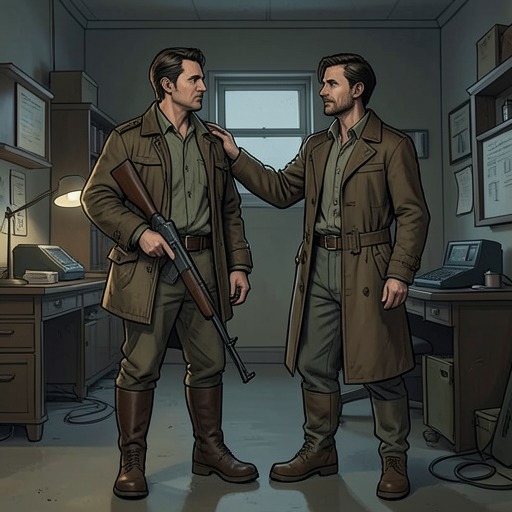
In the aftermath, the Colonel returned to the survivors covered in blood and dust, took Alicia by the hand, and announced that he would care for her. Alicia had been orphaned, and no adult in the room challenged his decision. The moment establishes a relationship grounded in responsibility rather than kinship: he chooses to raise a child who has lost her family, and the Colony accepts that promise because his actions have already demonstrated its seriousness.
Mentor and Protector
The Colonel raises Alicia in his hut beneath the Wall and later trains her in the practice areas. His teaching draws on his experience outside the settlement, combining fighting skills with a discipline of composure. He teaches her to think of herself as already dead when the infected arrive, a lesson intended to make action possible under extreme threat rather than to encourage recklessness.
Alicia learns quickly. At eight, she becomes an apprentice to the Watch, where she soon surpasses others in skill with bow and blade. By fourteen, she serves as a runner on the catwalk, moving between firing platforms. The Colonel’s guidance therefore has consequences beyond their private bond: it helps prepare Alicia for a role in the Colony’s defense and contributes to her emergence as a capable protector in her own right.
Return and Death
The Colonel’s own father never returned from a journey to Milagro in the Darklands, where he was believed to have died in an attack by the infected. Before that, he had claimed to see a lone Walker moving through the moonlit shadows. The Household and Old Chou had turned against the Long Rides, and the father’s disgrace and departure on solitary expeditions meant that his report went untrusted. Peter later understood that his father’s disappearance had been a death, but the earlier sighting of a Walker gives the Colonel’s history an echo of the very phenomenon his father had described.
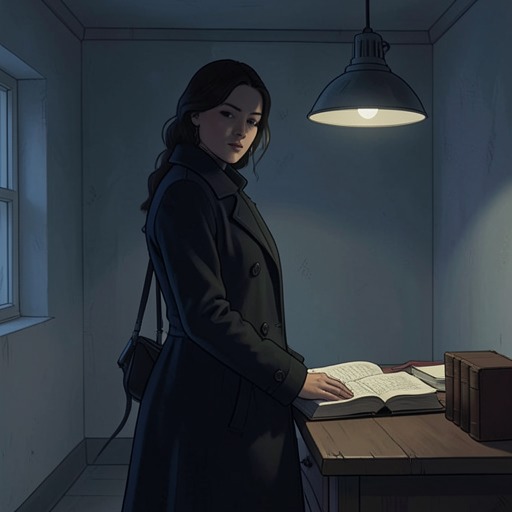
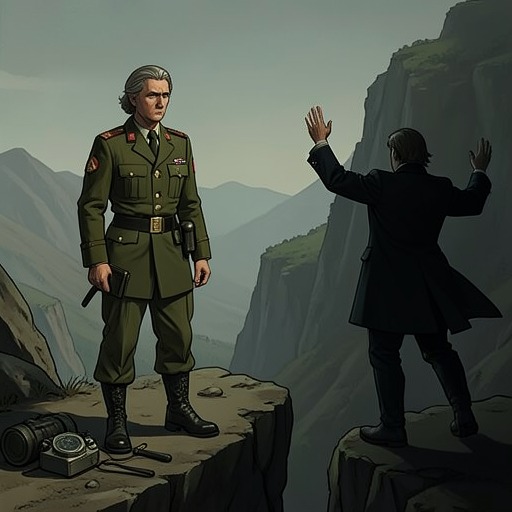
Much later, on a quiet night, the Colonel appears on the catwalk near Firing Platform Three, shortly after half-night. The open ground beyond the walls is lit by the Colony’s spotlights, and those who notice him assume that the old man simply cannot bring himself to stand down. Then he runs toward the people there. They watch him die. The account identifies the Colonel as the beginning of the crisis, but the evidence supplied does not explain why he went toward them or establish what prompted his final action.
Legacy and Narrative Significance
The Colonel’s story is shaped by repeated acts of going out: he leaves the safety of the Sanctuary to seek survivors, brings them back to shelter, and takes responsibility for Alicia when she has no one else. His later appearance on the catwalk reverses the meaning of that protective pattern. This time, he runs toward danger without a clear explanation, and the people who knew him are left with the gap between his familiar vigilance and his unexplained final choice.
That gap becomes explicit in a question about whether the Colonel was the sort of person who would simply let go. The question does not resolve the mystery; it records the difficulty of reconciling his death with his established character. His legacy consequently has two parts: the concrete protection he offered, which helped preserve the Colony and formed Alicia, and the unanswered circumstances of his final night, which make his death the opening point of a wider reckoning.